Tuesday, 12 July 2022

Ann Given, wife of Armour Sproule of Mullaghabane

We have not yet established who exactly Armour Sproule was, but, thanks to the 1900 letter, we know quite a bit about his wife, Ann Given.  Ann was a well connected lady and there is a bit of a story here.

The 1900 letter that had been sent to her granddaughter, Mrs Hugh Keys, formerly Sarah Sproule, had opened the door to the family history of Ann Given. The letter had been sent by Charles Cooper, Sarah Sproule's brother-in-law, and it had family history from Rev. Edward Edwards. The letter told us;

 “Sarah Sproul her father’s mother was Ann Givan, daughter of Mary Jane Stuart, who was a sister of Sir George Stuart. He was the landlord of the parish of Straws and inherited a good many other properties. They were first cousins of the Countess Ross of Castle Gore. The Reverend Edwards said that they were the nearest relations of King James Stuart and any of the Stuart.”

The Rev Edward Edwards had died some 20 years before this letter was written, and so it would be understandable that some of the details may have been embellished in the intervening years. However,  this part of the letter seems to have been very accurate, though I didn't look into the ‘nearest relations to King James Stuart’ part!

The letter had told us where exactly  to go to find the family history of Ann Given. We must go to the Edwards Family Tree. (Note – the name ‘Stuart’ is also spelt ‘Stewart’, and I‘m going to stick with Stewart spelling here.)

We are looking for Mary Jane Stewart, who is connected to Olivia Edwards, the Countess of Rosse, who was the heir to the Castle Gore estates and to the Manor of Hastings. The Edwards Family Tree is vast, but I knew exactly where to go immediately, as I had come across this Stewart-Edwards marriage when I was researching the Golan Sproules. The Stewart marriage was situated very close on the Edwards tree to the marriage of Martha Edwards of Kilcroagh to Robert Sproule of Golan in the early 1700s.

Martha Edwards was the daughter of Robert Edwards of Kilcroagh and Martha La Vie, and she was born some time around 1700. And, yes, right next to that Golan Sproule marriage on the Edwards Tree is the marriage of Mary Edwards of Kilcroagh, sister of my Martha, to Robert Stewart, and it even tells us that this marriage took place on 9 Sep 1726.

From "A Table of some Descendangs of  Hugh Edwards, who died A.D. 1672"

The letter was fairly accurate on the Edwards relationship, when it said “They were first cousins of the Countess Ross of Castle Gore”, for Mary Edwards is the 1st cousin 1x removed of Olivia Edwards, the Countess of Rosse.

The Edwards Tree tells us that the father of Robert Stewart was George "Roe" Stewart of Termon, in County Donegal. Robert Stewart, husband of Mary Edwards, was a minister at the church in Carland, County Tyrone, and he preached in Irish. That is quite significant, as the Plantation folk generally shunned the Irish language and it was spoken only by the native Irish. 

The Edwards Tree also confirms what the letter says, that Robert Stewart inherited land in Straw or Strews in Londonderry;

“Inherited Strews, part of the grant to Robert, father of William Stewart (who married Mary O'Neill, gd dau of the Earl of Tyrone) and 5th s/o Andrew, 2nd Lord Ochiltree, buried in Newmills churchyard”

It looks as if Rev. Robert Stewart who married Mary Edwards, was indeed descended from the Lords of Ochiltree, a Scottish title created in 1543 for an Andrew Stewart. There was a long line of Andrew Stewarts holding this Lord Ochiltree title until the last Andrew Stewart sold it off in the early 1600s. Our Robert Stewart is descended from this last one.

From A Pedigree of the family of Stewart, of Castlestewart, Vol 2 1892 John O' Hart


But that’s not the interesting part of this story.  Rev. Robert Stewart and Mary Edwards had 10 children, the 9th child being Mary Jane Stewart, born about 1744, who was to become the mother of our Ann Given. However, Rev. Robert Stewart died just 2 years after her birth, on 12 April 1746 and I believe that his wife Mary died round the same time, although I can’t find a record of her death.  The children were now orphans. 

Their daughter, Mary Jane Stewart, the Edwards Tree tells us, was taken in by her cousin, Olivia Edwards, the Countess of Rosse and she lived at Castle Gore. At some stage the bold Mary Jane Stewart eloped with a gentleman named James Given of Langfield!

From A Pedigree of the family of Stewart, 
of Castlestewart, Vol 2 1892 John O' Hart

Unfortunately, the Edwards tree does not tell us why they eloped, but it can’t have been that the Given family was an ‘unsuitable’ family. Martha Edwards, a first cousin of Mary Jane Stewart also married into this Given family of Langfield. She married a man named George Semple of Mullaghabane, who’s mother was Sarah Given. This Sarah Given was the sister of James Given that Mary Jane Stewart had married. So there’s kind of a Mullaghabane / Given link there too. 

So James Given and Mary Jane Stewart eloped and lived in the Parish of Langfield, where, no doubt, their daughter Ann Given was born.

We can locate James Given of Langfield from his death date written on the Edwards Tree – 1792. From this we find him in the Index to Wills in 1792. 

 Ireland, Indexes to Wills, 1384-1858, Ancestry.com

James Given is living in Unshinagh, in Langfield Upper, now Longfield East. George Given, the son of James Given and Mary Jane Stewart, is there in Unshinagh in the Tithe Applotment, and he has 46 acres. His holding has grown to 115 acres by the mid 1850s.

Meanwhile our Ann Given has married Armour Sproule of Mullaghabane. If we leave out the 'elope' bit, this would be quite a 'good' marriage for a small farmer in Mullaghabane, even one connected to the Grennan Sproules. Does this hint at Armour having friends in high places? 

Maybe, or maybe not!


4. How did Armour Curry Lowery Sproule get his Name? 

5. The Letter to Mrs Hugh Keys, Sarah Sproule of Mullaghabane


Saturday, 2 July 2022

The Letter to Mrs Hugh Keys, Sarah Sproule of Mullaghabane

This is the document that David Walter sent to me in 2017, containing the family history of Sarah Sproule, then Mrs Hugh Keys, granddaughter of Armour Sproule and Ann Given. As you can see it is a typewritten transcript of a letter, supposedly sent to Mrs Hugh Keys in her home in Australia in about 1900. There is no provenance for this 1900 letter, we don't know where it came from. However, I knew immediately that the information it contained had indeed been sent to Sarah Sproule, and that she had definitely recieved it. The reason was that the information contained in the 1900 letter was largely the same information that had appeared in her newspaper obituary when she died in 1919.  The obituary authenticated the 1900 letter.  

 Robyn Ritchie had sent me a copy of this lovely obituary of Mrs Hugh Keys from Trove a couple of years earlier - thanks Robyn.(See below) However, I very much doubted the family background in the obituary, especially this section begins,

"Mrs. Hugh Keys, was a native of Drumbulkin, County Fermanagh"

 To be honest I didn't look much further, as Sarah Sproule was definitely was not a native of Drumbulcan. How could her family not know that? Sarah Sproule was born on 18 Nov 1838, in Mullaghabane, Dromore, County Tyrone, the daughter of James Sproule of Mullaghabane and Ann Blayney. (Dromore Church record) I assumed that the rest of the newspaper obituary was also fantasy.

And then I got the 1900 letter, with the family history that had been written by Rev Edwards and Charles Cooper. This not only validated the letter, but the letter also validated the obituary! And the 1900 letter also explained why her family thought she was from Drumbulcan when they had written her obituary. In the 1900 letter there is a title which begins her family history and this title is,

"The Genealogy of Mrs Hugh Keys of Drumbulkin, County Fermanagh, Ireland."

She was indeed 'Mrs Hugh Keys of  Drumbulkin' as she had married Hugh Keys, a farmer from Drumbulcan, Derryvullan, Fermanagh. (1831-1893) That was her last home in Ireland. However, she was originally Sarah Sproule of Mullaghabane. The confusion was explained.

Now this letter also heads the reader in the right direction for the family of Ann Given and Ann Blayney, but the detail of those families is not actually accurate. We will look at those in the next posts.

The Letter to Mrs Hugh Keys, Bundaberg, Queensland, Australia

The 1900 Letter to Mrs Hugh Keys, Sarah Sproule of Mullaghabane.

The Obituary of Mrs Hugh Keys

 Sarah Keys died on 27 May 1919 and her Obituary appeard the following day in the Bundaberg Mail. I have given just the lovely beginning here, transcribed by Robyn Ritchie, well worth a read! The rest of the obit gives the family history and it contains some incorrect information, so I won't include it here.


Bundaberg Mail,
28 May 1919, p.4

"A veritable pioneer passed away at an early hour yesterday morning in the person of Mrs. Hugh Keys, senr., the venerable mother of several of Bundaberg and district best known residents and who had resided here for about thirty-five years, having seen the place grow from a village to a new city of great importance.

Mrs. Keys was a fine old soul, possessed of the stamina that was so directly a feature of the pioneers that paved the way for the present day generation, and to who’s sterling qualities a wilderness was transformed into a land of rich productiveness. The deceased lady had been ailing for several weeks and had taken up her residence with her second eldest daughter, Mrs. Erikson, of East Bundaberg. But until then, despite her upwards of four score years, she had resided in her own little home in West Bundaberg, enjoying good health and activity. 


Friday, 1 July 2022

How did Armour Curry Lowery Sproule get his Name?

Where did it come from? How did Armour Curry Lowery Sproule get a name that was almost identical to that of Armar Lowry-Corry, Lord Belmore? We have looked at one possibility in an earlier post. This time we will look at a few more. Now I am a facts and figures type of person, and a post based entirely on speculation is very rare for me, but I have to emphasise that this one definitely is. My motivation is to encourage a male Sproule descendant of the Mullaghabane Sproules to come forward for Y-DNA, to help us to get closer to the truth. So, here we go...

Are John Sproule of Grennan and Lord Belmore somehow linked?

Firstly we'll ask the question, could John Sproule have named his child after someone that he knew personally? Were they friends, or relatives, or had some kind of personal relationship? The short answer to this is no, I can find no connection between these two at all. They definitely were not related. They are roughly the same age, Armar Lowry was born in 1740 and John Sproule in 1744, but they grew up on opposite sides of County Tyrone, very far apart. Armar Lowry was raised in Aghenis, in the parish of Aghaloo, in the far east of Tyrone, and John Sproule was in Grennan, parish of Dromore, in the far west.

Grennan where John Sproule lived, and Aghenis where Armar Lowry was reared

They couldn’t have met at school or in the army. According to Somerset Richard Lowry-Corry, his great grandson, Armar Lowry was educated by a tutor at home and he did not graduate from any university. He wasn’t in the army either. [1]

After 1774 Armar Lowry-Corry was the landlord of John Sproule, John was leasing land in 3 townlands that were owned Armar. However, that process would not normally have involved either of them meeting or communicating in any way. Armar Lowry had agents to look after each of his estates. Each of the agents would have had bookkeepers to record all of the due rents and payments. John Sproule would have met the bookkeeper when he was paying his rent. He would probably only have dealt with the agent when there was a lease to renew, a default on payment or some other issue. He would be nowhere near Armar Lowry-Corry. [2]

Under normal circumstances, therefore, I don’t believe these two would ever have met at all, never mind have been friends. And abnormal circumstances? We don't know anything about those, of course! Maybe Armar Lowry-Corry  wanted to improve his swordsmanship and duelling skills from the expert swordsman, John Sproule of Grennan! 

So there doesn’t seem to be any logical reason why John Sproule of Grennan would have chosen this name, Armour Curry Lowery Sproule, for his child.

What if this wasn’t John Sproule’s child?

From my earliest look at Armour Sproule, it did occur to me that there was the possibility that Armour was, in fact, not the child of John Sproule at all. He could be an ‘illegitimate’ child that John Sproule was raising as his own. There are a couple of options to be considered when looking at this possible scenario. The first is that Armour Sproule is the child of Armar Lowry-Corry and a Grennan Sproule female. I actually kept this one alive until fairly recently, even though it really made no sense at all!

I couldn’t make it work in any scenario that I considered. Let’s paint the picture.  The lady in question could be the daughter of John Sproule of Grennan, or maybe it is his sister, and this Sproule lady has got pregnant by Armar Lowry-Corry. Let’s say that John Sproule decides to bring this child into his family and to raise him as his own. 

Now, in this situation is he likely to give this child the name of the man who had disgraced the lady in his family - Armar Lowry-Corry? And even if the child did have that name, and John Sproule accepted that, would John also have given him his own Sproule name? Ah, no, definitely not. I couldn’t see that happening at all. That is broadcasting the scandal to the whole countryside!

But even if we got past the name issue, there were two other big practical problems. First none of the dates added up.  John Sproule’s eldest daughter would have been too young to have a baby round 1780 when Armour was born. His eldest daughter was Mary who married Chadwallade Blayney and she was born round 1768.[3] And any sister of John Sproule would probably be too old for Armar Lowry-Corry.

And the second problem was even bigger, it was back to how could they possibly have met? Grennan was a long way from either Aghenis or Castle Coole - the two places where Armar Lowry had lived. It couldn’t really happen.

But there is a second option to this ‘illegitimate’ child scenario, a different one that I am favouring at the moment. The more I learnt more Armar Lowry-Corry and also, more recently about John Sproule of Grennan, the more likely I think this option becomes.

Did Armour Sproule have any Sproule blood at all?

When we look more closely at Armar Lowry-Corry, Lord Belmore, we can actually get some indication as to how he would treat a child of a lady with whom he had had some dalliance. (I read those regency novels too) To be honest, I was surprised when I saw this.

When Armar’s second wife, the young Lady Henrietta Hobart-Hampden, left him in about 1781 and returned to London, he remained ‘single’ for quite a while.  During this time Armar had liaisons with two ladies who lived on the Castle Coole estate, and Armar had children with both of them.[4] One of these ladies was apparently a Miss Bowen, the coachman’s daughter, and the other a Margaret Begby. If this is true, it must have been public knowledge, made more so by the names that Armar Lowry-Corry gave to these children.

Margaret Begby gave birth to a daughter in 1784, her name was Emily Maria Lowry Corry. In 1787 Margaret Begby had a son, and he was called John Corry. Both children got Corry names, and on Lowry Corry.

In 1793 Miss Bowen, the coachman’s daughter, apparently gave birth to a son and he was named Armar Lowry Corry! If this is true, that this Armar Lowry Corry was the son of Miss Bowen, he still managed to go on and have a very successful career in the Royal Navy, rising to the rank of Admiral. (1793-1855)

I also noticed his name on the bottom of some of the encumbered estates documents in the mid 1850s, and this certainly supports the idea that he is, indeed, the son of Miss Bowen.

Capt. Armar Corry Lowry named Encumbered Estate, Townland of Gortaclare

In very tinly writing at the bottom of that page, it says;

"This lot will be sold primarily subject to £23 8s yearly to be paid thereout on foot of an annuity of £1076 18s to Julianna Countess of Belmore and £40 12s yearly to be paid thereout on foot of an annuity of £184 12s to Captain Armar Lowry Corry R.N...."

Julianna Countess of Belmore has the large annuity. She is the daughter of Armar Lowry-Corry and Margaret Butler, his first wife. Captain Armar Lowry Corry has an annuity considerably smaller.

So we see a definite pattern of Armar Lowry-Corry giving his children who were born out of wedlock his own name, even his full name. These liaisons took place after the marriage of Armar Lowry-Corry to Henrietta in March of 1780. So let's look at what was going on before this marriage. His first wife had died eight years before in 1772. There is an eight year gap in between  these events in which Armar Lowry-Corry would certainly have had one or more liaisons with local ladies. It is logical also that if the couple had children, he would be likely to have given them some or, indeed, all of his own name too.

 So now we come to the beginning of 1780 and there is a marriage arranged between Armar Lowry-Corry and Henrietta, the daughter of the great and good Duke of Buckinghamshire. This is a huge event. I can readily envisage that Armar Lowry-Corry would be very be anxious to tidy up his affairs before the big day. What to do with his lady or ladies and the child or children? It was often the case that, if necessary, the ladies would be ‘married off’, and the child or children would go with them or, if not, would be adopted to some other good home. The new home would have to be situated some distance away from Castle Coole, just to be safe, and yet still within the area of the Lowry estates. Looking at what little I know of Armar Lowry-Corry, I believe he would have gone to some lengths to make sure that all were in good homes.

How would something like this be done? Again, this would be the role of the agents. There were two agents for Tyrone at this time, as we learnt from Sommerset Lowry-Corry, his great grandson,

“He appointed for his Tyrone estate prior to his mother's death, viz. — Messrs. James and Samuel Galbraith.” [1]

The Galbraith brothers, who were the agents, were the nephews of Armar, so he would be keeping this very much within the family. If it were the marriage situation, their task would be to find a suitable suitable man of reasonable means, who could support this lady and her child or children, and who would be willing to give them a good home. It would, of course, be known who the father of this child was, as he would still carry the name. I don't believe it would have been all that easy to find the right home. A home just for the child without the mother would have been easier. A financial contribution would also have been made of course.

And then we have John Sproule of Grennan, a farmer from a very well respected family, and who seems to be in great need of financial support! Would he marry a woman and take a child who tied him to the great Lord Belmore? Yes, I think this is possible, assuming he had no living wife at the time. Of course we don’t know, but I believe he would, whereas I wouldn’t believe the earlier suggestion. Or what about the second situation, would he take in the child with the Lowry-Corry name, into his own home, for a fee? Yes, I think he would.

How would the rest of the family react? Well, they wouldn’t be witnesses at a wedding of his daughter, that’s for sure!

So my bottom line from this whole story is this. My best guess is that there are two possibilities, and only two, why our Armour Sproule was given the name Armour Curry Lowery Sproule;

  1. Either -The Armour Curry Lowery Sproule is a nickname for the boy who was called simply, Armour Sproule 
  2. or John Sproule of Grennan took in a child whose parents were Armar Lowry-Curry and some unknown lady. He may or may not have married this lady. There may or may not have been other children, but one of these children was called Armour Curry Lowery Sproule.

Again, both of these could be very far from what was in fact the real truth! I only hope that I live long enough to find out!


References:

[1] The History of the Two Ulster Manors of Finagh, in the County of Tyrone, and Coole, p.41, Somerset Richard Lowry-Corry Earl of Belmore, Longmans, Green & Company, 1881

[2] Some information on this is in The History of the Two Ulster Manors of Finagh above, but most of my knowedge of the agent / landlord relationship comes from the extensive letters in PRONI between the Earl of Abercorn and his agent in Strabane, James Hamilton, also a relative of the Earl. 

[3] Mary Sproule, John's eldest daughter who married Chadwaladar Blayney, ended up in Prescot, Ontario, Canada. She is in the 1851 census there which gives her birth year as 1768. This is, of course, may not be accurate, but it effectively means that the chances of her having a baby before 1780 are slim to none.

[4] This appears in Ulster Archaeological Society Castle Coole,  Derryvullan, Co.Fermanagh, author  Ian Gillespie, in association with the National Trust 2015, where he quotes from the book Belmore : the Lowry Corrys of Castle Coole, 1646-1913, Peter Marson, Belfast : Ulster Historical Foundation, 2007

Other Posts in this Series;

2. Armar Lowry-Corry and the Mullaghabane Sproule  

3.  John Sproule of Grennan and the Mullaghabane Sproule

Tuesday, 28 June 2022

John Sproule of Grennan and the Mullaghabane Sproule

The traditional story is that the father of Armour Curry Lowery Sproule of Mullaghabane is John Sproule of Grennan. This John of Grennan lived in the 1700s, so do we know anything about him? Yes we do, but only a little. We knew even less about him until the last few years when Jamie Reid and I did a trawl through the Registry of Deeds on Familysearch.org. The deeds that we found concerning John of Grennan gave us some key information about his family history, and some snippets of interesting insight into his life. I can definitely tell you now that this John Sproule of Grennan seems to have been a bit of a character.

We first see this when we meet John Sproule on Jack Elder’s family tree of the 'Upper Grennan' branch, where Elder asks;

"Is this the John Sproule whom John Inch calls, Long Jack of Dullaghan’, who was a Lieutenant in the Irish volunteers of 1782, and an expert swordsman who fought a duel at Strabane with a military officer and cut off the latter’s right hand? Long Jack had a son Oliver and a daughter?”

No, Jack Elder, you have the wrong one. That John Sproule that you have on that Upper Grennan tree wasn’t Long Jack of Dullaghan’, but we have the right one!  We have the John Sproule who John Inch says was in the 1782 Irish Volunteers, and who cut off the military officer’s right hand in a duel. We are certain that we have the right one because the deeds that we found connect him tightly to Dullaghan, and to being, therefore, the person who warrants the nickname, ‘Long Jack of Dullaghan’. The deeds actually connect  John Sproule to three different townlands, to Grennan, to Dullaghan and to the townland of our current story, to Mullaghabane, where Armour Sproule lived.

Elder did not know where to place John Sproule of Grennan on the family tree, but Jamie Reid came to the rescue only recently. Jamie uncovered a key deed for this Grennan family that actually tells us when John Sproule was born and who his father is. (1747 Deed)

Grennan, Dullaghan and Mullaghabane in the Parish of Dromore

This deed is dated 11 June 1747, and in it, James Sproule of Grennan is leasing a farm in Dullaghan, from an Andrew Crawford. The date of this deed suggests that this James Sproule of Grennan is likely to be James, the son of Cornet Andrew Spreull,although he could also be a grandson.  On the deed, as is usual in those days, James Sproule names two ‘lives’, and these are two of his two sons:*

“Charles Sproul aged then five years and John Sproul aged then three yrs both sons to ye said James Sproul”

 So we know that Charles Sproule, son of James of Grennan, was born in 1742 and that John Sproule of Grennan, son of James, was born in 1744.

What else did we discover in the deeds? Well, another significant one was the marriage Mary Sproule, daughter of John Sproule of Grennan, to Chadwaladar Blayney of Oughterard in 1792, a deed that was also in the Registry of Deeds on Familysearch.org. I found this deed fascinating. It was a marriage settlement deed, a normal procedure at those times. The idea of the settlement was financial, to create a fund, or a trust, in case the husband should die. This, then, would provide for the wife and any children.

Normally it names the couple, like Chadwaladar Blayney and Mary Sproule. It also typically names the father of each of the couple, John Sproule and Ambrose Blayney in this case. Sometimes there are trustees, who will look after the trust for the wife, usually two people, one from each side. This isn’t done this time, the money was small. Then there are witnesses to the settlement, again usually one from each side.  

When I transcribed this marriage settlement, I wrote a note at the bottom,in bold red;

It was very striking. There were 3 witnesses, none of them are Sproules. I have never seen that before or since. Only later did I realise, there were no Blayneys either! There is something very odd going on here. There is no brother of either of the couple standing as a witness, nor anyone else baring either of their names.  Did Mary Sproule, daughter of John Sproule, have no brothers old enough to be witnesses in 1792? What about her father's brothers or other Grennan Sproules– were there no male Sproules there who would be witnesses? There are plenty of Blayneys in the neighbourhood, Chadwaladar Blayney definitely had a brother Ambrose, if not others. But no Blayney witnesses. Odd.

We’ll move on to see what the other deeds reveal about John Sproule of Grennan. I'll give you a very quick summary which I have arranged to give you a timeline. The year of each deed is on the left, and the note on each on the right shows something that stands out a mile!

1744

John Sproule of Grennan is born.

1782

John Sproule is a Lieutenant the Irish Volunteers (From Elder)

1784

John Sproule of Grennan is borrowing money from Oliver Sproule the Apothecary in Omagh. For this he mortgages land in Grennan, Dullaghan and Mullaghbane

1790

John of Grennan is borrowing money from Oliver Sproule the Apothecary mortgaging just the Dullaghan land.

1792

Marriage of Chadwallader Blayney, son of Ambrose Blayney and Mary Sproule, daughter of John Sproule of Grennan

1792

John of Grennan is borrowing money from William Stephenson  - mortgaging the land in Dullaghan.

1798

John is now called John Sproule of Dullaghan. He is borrowing money this time from his son-in-law, Chadwalader Blayney. He is mortgaging land in Mullaghabane and Dullaghan ‘formerly held by James Sproule father of the said John’  

There is a lot of money borrowing going on there! Between the money and the duel we learnt about earlier, this John Sproule comes across as what my mother would call ‘a profligate’. (She loved regency novels!) We will never know why John Sproule borrows money or what he does with his money. What we do know is that this man does need money.

Now, we have looked at Lord Belmore, Armar Lowry-Corry, and we have looked at John Sproule of Grennan. What, if anything, connects the two? Why would this John Sproule of Grennan call one of his sons after one of the highest Lords in Ireland? Why would he call him Armour Curry Lowery Sproule?  


The Deeds

1747 James Sproule of Grennan leases Dullaghan farm from Andrew Crawford, 1 June 1747, 148 198 99167, Registry of Deeds Dublin, Familysearch.org 

1784 John Sproule of Grennan borrowing  from Oliver Sproule the Apothecary in Omagh Grenan, mortgaging Dullaghan and Mullaghbane. 354 540 240500, Registry of DeedsDublin, Familysearch.org

1790 John Sproule of Grennan mortgaging Dullaghan to Oliver Sproule the Apothecary, 1 January 1790, 451 218 289682, Registry of Deeds Dublin, Familysearch.org

1792 Marriage of Chadwallader Blayney, son of Ambrose Blayney and Mary Sproule, daughter of John Sproule of Grennan, 11 Apr 1792, 478 553 311812, Registry of Deeds Dublin, Familysearch.org

1798 John Sproule borrowing from Chadwalader Blayney, his son-in-law.  10 Feb 1798, Registryof Deeds Dublin, Familysearch.org


** The ‘lives’  in a deed provided a measure of time. Some deeds last for a period of years, e.g. 40 years. Other deeds last for the length of time someone lives, a named person on the deed. When that person dies the deed expires. Usually, the names on the deeds were the youngest possible people, for obvious reasons. Two or three names were usually given and the deed expired when the last one died. A third type of deed were ‘perpetual’ deeds. These had named ‘lives’ in the same way, but the names could be replaced. So when the last one dies, 2 or three new names go on to the deed. This can go on forever.

Other Posts in this Series;

2. Armar Lowry-Corry and the Mullaghabane Sproule 


Monday, 27 June 2022

Armar Lowry-Corry and the Mullaghabane Sproule

 We have been looking at the Sproule with the odd name, Armour Curry Lowery Sproule. In this post we will look at one of the characters who are of interest in the telling of Armour’s story, the man in the title above.

Some of you folk may think that the name in the title is that of our Armour Sproule.  Observant folk, especially those who know me well, might just assume that Kate has again misspelt something, on this occasion our Sproule man’s name in the title. But that’s not him - that's not our Sproule man.  Armar Lowry-Corry is an astoundingly similar name, but that’s not our Armour Curry Lowery Sproule of  Mullaghabane. This man is a very, very far cry from the life of a small farmer living on 11 acres of leased land in Mullaghabane.  This man owned Mullaghabane, he owned Grennan, he owned much, much more.

Armar Lowry, for that is the name that he was born with, was the son of Galbraith Lowry and Sarah Corry, born on 07 April 1740 in Aghenis, County Tyrone. By a series of early deaths and lack of male heirs,  Armar Lowry inherited 3 different, very large estates, the Lowry, Corry and Armar estates. By 1779, Armar Lowry had become an extraordinarily affluent man, probably the richest in Ireland, owning over 70,000 acres of land in 6 different counties, including large tracts of land in Fermanagh and Tyrone.  


Armar Lowry-Corry (1740–1802), 1st Earl Belmore, by Robert Hunter (c.1715/1720–c.1803), National Trust, Castle Coole


When his mother’s family estate, that of the Corrys of Castle Coole, County Fermanagh, came to Armar in 1774, he added the name ‘Corry’ to his own ‘Lowry’ name. (It was part of the Will of John Corry that the heir should do this) His home estate remained there at Castle Coole, where, in the late 1700s, Armar built a new house, the most elaborate house in Ireland.

Castle Coole, near Enniskillen, Fermanagh, National Trust

Armar Lowry-Corry was not only rich, he was a Member of Parliament and he was very well connected. This helped him to also marry well, as they say. His first wife, Margaret Butler, was the daughter of an Earl, the Earl of Carrick, and the granddaughter of another, the Earl of Shannon, one of the most powerful men in Ireland at that time.

But Margaret died in 1772 and later Armar married an even higher ranking lady, Lady Henrietta Hobart, daughter of the 2nd Earl of Buckinghamshire.  That marriage, by the way, was a disaster! It was an arranged marriage, and the 17 year old Lady Henrietta hadn’t set eyes on Armar before the wedding. She stayed only a short time in Ireland, just long enough to produce a daughter, and then headed off to sow her wild oats.

On 6 January 1781 Armar Lowry-Corry was raised to the peerage. The story goes that he wanted to take the name ‘Fermanagh’ – Baron Fermanagh. However, this name was already used by an English peer. Apparently, it was his wife, Henrietta, who chose the name Belmore, after a hill in County Fermanagh,  and he took that name. He later became Viscount Belmore and then Earl Belmore.

Armar Lowry-Corry was Lord Belmore. The ‘Belmore’ part of the name was introduced in 1780 – no earlier.

So now you see the dramatic similarity in these names, and equally just how incongruous this similarity is! Armar Lowry-Corry, the affluent, high ranking Lord Belmore, and Armour Curry Lowery Belmore Sproule, the lowly, small farmer from Mullaghabane.

How could Armour Sproule possibly have acquired this name? Well, the first possibility was that this name was an ‘Ancestry myth’, but we’ve have established that the name was known long before this. It was on a document in written about 1900.

The second obvious possibility that hit me was, could Armour’s name long name have been a nickname? Our Armour Sproule is believed to be the son of John Sproule of Grennan, and he has to have been born somewhere round 1780, exactly the time when Armar  Lowry had just acquired all of his estates and was about to become a Baron.  Armar Lowry-Corry was the landlord of the Grennan Sproules, and his rise to fame would have been well known to those local families of Grennan.  It would be a natural thing to give young Armour Sproule that nickname, adding Curry Lowery Belmore to his own name.

That is a definite possibility. However, when I saw the letter to Mrs Hugh Keys, which contained information that I believe only the Rev Edward Edwards could have known, the nickname theory became less likely. If the Rev Edward Edwards had known this long name to be a nickname, and he definitely would have known that, he would have said so – they always did. John ‘Jack Roe’ Sproule of Curraghamulkin was never called Jack Roe Sproule in documents of any kind. He was John Sproule, or as it is written above with the ‘Jack Roe’ in quotes. The writers of the 1900 letter, Charles Cooper and Edward Edwards, would definitely have said in the letter something like, “Armour Sproule, known locally as …” They didn’t do that.

The nickname is still a possibility, but I believe there is a also strong possibility that it actually was Armour Sproule’s real name.

In the next post we’ll look at the other character in this story, the father of Armour Sproule, John Sproule of Grennan.

Other Posts in this Series;


The information on Armar Lowry-Corry came from the following:

  1. Introduction to the Belmore Papers, PRONI D3007, Nov 2007
  2. The History of Castle Coole from the National Trust
  3. Ulster Archaeological Society Castle Coole,  Derryvullan, Co.Fermanagh, author  Ian Gillespie, in association with the National Trust
  4. The History of theTwo Ulster Manors of Finagh, in the County of Tyrone, and Coole, Somerset Richard Lowry-Corry Earl of Belmor, Longmans, Green & Company, 1881
  5. Armar Lowry-Corry (1740–1802), 1st Earl Belmore, Robert Hunter (c.1715/1720–c.1803), National Trust, Castle Coole

Sunday, 26 June 2022

Armour Curry Lowery Sproule

I came across this extraordinary name in about 2013, not long after  I began researching on Ancestry. There it was on a couple of Sproule Family trees. It was a ridiculous name, Armour Curry Lowery Sproule. It was too ridiculous to be true. Over the years I have dipped in and out of this story, hoping to bring a definite conclusion to the mystery of the Armour Sproule name. I haven’t quite got there yet, but now I feel it is time to give you what we know so far… and what I suspect!

Armour Sproule - Did he exist? Was he real?

By about 2014, I began to ask, could there really have been an Armour Sproule? Did he exist at all? Although Armour isn’t a Sproule name, it was a name of those times, that is, the late 1700s. I began to look at those Ancestry family trees, and I also had a search round the records, and it quickly became very clear that the name Armour Sproule did indeed exist.

The earliest document that I found was an immigration entry into New York in 1816, for one ‘Armour Spraule’, who was the 'primary passenger'. This looks like the family of an Armour Sproule had entered the US in 1816, we assume from Ireland.

1816 Arrival in New York
Name: Armour Spraule
Arrival Year: 1816
Arrival Place: New York, New York
Source Publication Code: 1742
Primary Immigrant: Spraule, Armour
U.S. and Canada, Passenger and Immigration Lists Index, 1500s-1900s Ancestry.com

 We then have the Armour name occurring in a family in Prescott, Ontario. This is the family of a John Sproule who married a Mary Ann Barton, and they called their first born, Armour Sproule. The two married on 3 Nov 1840 in Middlesex, Ontario, and interestingly, two Blayney boys are witnesses at that wedding.

The wedding of John Sproule and Mary Ann Barton, Ontario, Canada, Marriages, 1826-1938

So we know that Armour and his family arrived in the US in 1816, and almost certainly went on to Prescott, Ontario.  But were did Armour live before he left home?

Where was Armour Sproule from?

The answer to this was revealed in the Dromore Presbyterian Church records in PRONI, for these records led me  to the townland where Armour Spoule and his family had lived.

In about 2015 I visited PRONI and recorded some records from the Dromore church. First there is the marriage on the 2nd February 1838, of a James Sproule who we learn is the son of Armour Sproule and Ann Sproule alias Given. James married Anne Blayney daughter of Ambrose Blayney and Elizabeth Blayney alias Smith of Dullaghan, Parish of Dromore. (Dromore Presbyterian Church records, PRONI)

The place where James and Armour Sproule lived is not there on the Church marriage record, but we find it on the birth records of the couple's children in the same church.  Ann Blayney and James Sproule lived in the townland of Mullaghabane, Dromore,  County Tyrone, and they had had 3 children baptised Sarah, Elizabeth and Charles. So Armour Sproule and his wife Ann Given were resident  in Mullaghabane.

Now we have established that there was indeed an Armour Sproule and that he lived in Mullaghane. We know that he left Ireland in 1816 and that he had at least two sons. His son John probably left Ireland with the father and mother and went to live in Prescott Ontario.  If we look at the 1851 Census in Prescott at the family of John and his wife Mary Ann, we see that there is a visitor, Ann Sproule, and that she is aged 68. This is very likely to be his mother Ann Given. 

Visitor Ann Sproul with John Sproul in 1851 Census Canada East, Ancestry.com

The other son James Sproule, who married Ann Blayney had stayed in Mullaghabane, and James died there in 1842.

Could he REALLY have had that name?

What about all the other names this Armour Sproule of Mullaghabane is supposed to have? The whole 'Armour Curry Lowery', thing?  

So far I had found no trace of a document showing anything other than the name 'Armour'. No sign at all of all of the rest of this elaborate name. It doesn’t take a genius to look at this name and to make the connection between this name and the name of  a very important person at that time, a peer of the realm, no less. Hold that thought, more to follow. But first, was this name real?

In 2017, I was sent a document by a gentleman named David Walters, a very important document. I am very grateful to David for sending it to me.  The document was a typewritten page, a transcription of a letter that had been written to Mrs Hugh Keys, Bundaberg Region, Queensland, Australia, and it was sending her the family history! Mrs Hugh Keys was Sarah Sproule, born 18 Nov 1838, daughter of James Sproule of Mullaghabane and Ann Blayney, and granddaughter of Armour Sproule.

This letter with her family history was sent to Sarah Sproule in Australia in about 1900 and it had two different names as 'sender', the Rev Edwards and Charles Cooper in Ireland.

The family history begins:

And there we have it. There is the name Armour Curry Lowery Sproule, in a document was written about 1900. Quite amazing. Who were the writers of this letter? Did they have any knowledge of this family? Or maybe they just composed this elaborate name?

Charles Cooper, one of the writers, is the brother-in-law of the recipient of the letter, Sarah Sproule. Charles Cooper was married to Elizabeth Sproule, her sister.

But it is the Rev Edwards who caught my eye, and it is he who is particularly interesting. First of all, he was a Reverend, and they tend to know family things. But also, he is related to this family, as it happens doubly so! 

There is only one Rev. Edwards that I know of in this neighbourhood, and I checked again this week with local folk to make sure. There was only definitely only one Rev. Edwards in the area, but he was not alive in 1900 when this letter was sent. Rev. Edward Edwards had died in 1881. He was one of the Edwards of Kilcroagh and Castle Gore, born in 1802, the son of Nehemiah Edwards and Elizabeth Sproule.

Edward Edwards is related to both Armour Sproule and to his wife, Ann Given. He is distantly related to Armour through his mother, Elizabeth Sproule and he is the second cousin of Ann Given through his father, for she was also from this Edwards family.

What makes me doubly certain that Rev. Edward Edwards who died in 1881 actually wrote this family history, and passed it on to the Mullaghabane family, is that there is information in the letter that only he could possibly have known. More on that in a later post.

The Rev. Edward Edwards should certainly know the full name of Armour Sproule. 

That would lead us to believe most, if not all, of what is contained in this letter to Mrs Hugh Keys. This letter written in 1900 says this man's name is Armour Curry Lowry Belmore Sproule.

It also says that John Sproule is the father of Armour Curry Lowery Belmore Sproule. John Sproule of Grennan, that is.

That leaves us with the BIG question. 

Why in god’s name would John Sproule of Grennan call his son Armour Curry Lowery Sproule???

If his father was John Sproule of Grennan, why would he possibly give is son that name? But before we can even consider the BIG question, we need to look at two more players in this story...


Monday, 6 June 2022

Captain Andrew Sproule of the Solebay

I was looking through Findmypast newspapers to see if there is anything new for me – the newspapers  are free access here this week. A little random entry caught my eye in Saunders' News-Letter, Dublin, of 31 December 1807. It looked like a small advertisement, but it was, in fact, a letter that had been written on a ship called the Solebay and the ship was at sea at the time the letter was written;

Saunder's News-Letter, Dublin, 31 Dec 1807, Findmypast

Now if that were an Irish reference, it would be years before I would locate this A. Sproule. But this letter was all about the English navy and A. Sproule was from an English family, and two hours later I had A. Sproule’s entire Navy record, and his family history back to the 1600s! (With a little help from a friend!)

This letter of 1807 tells us that A. Sproule was on the ship, the Solebay, when he chased and captured the privateer lugger, the Estrella del Noste, of Vigo. So this was a good place to start, with the names of these two ships. Up it popped straight away. Captain Andrew Sproule, for that was his name, had taken over command of the Solebay in 1807. The Estrella del Noste was a Spanish ship, which puzzled me a bit since the British were at war with the French at the time, not the Spanish. However, then I saw a nice little entry that explains all. Captain Sproule's frigate, the Solebay, met the Elstrella del Noste off the Leeward Islands, in the Caribbean. Here the Spanish and the British always had difficulty. 

The Naval Gazetter, Biographer and Chronologist, J.W. Norie, 1842
Anyway, back to our Captain Andrew Sproule. There are fabulous navy records online now, and on a site called The Three Decks Forum we have a whole history of Captain Sproule and the ships he was on from his first appointment as a Lieutenant in 1782;

From the excellent site Three Decks Forum

Both of Captain Sproule's last two ships, the Dorset and the William and Mary, were Royal Yachts, and Captain Sproule seems to have spent most of his time on these Yachts sailing between Ireland and England.

Who, then, was this Captain Andrew Sproule?  His Will was in the UK National Archives, written on 5 Jun 1820, and proved in 1822. (PROB 11/1664/131) The Will gives us everything that we need to begin tracing his family. We learn that Andrew was married to Harriet Letitia, and that his eldest daughter had the same name,  Harriet Letitia Sproule. The Will tells us that the next daughter, Catherine Elizabeth, was married to a Rev. George Bisshopp, and that there was another daughter, Anna.

So with that information over to Ancestry.com and there we can find Harriet Letitia, the eldest daughter, who was baptised on 3 Dec 1788  in Clifton, near Bristol, in England. (Bristol Church of England Parish Register, Reference: P/AL/R/3/a Ancestry.com)

Baptism of Harriet Letitia Sproule

 I found the daughter Anna in the same Bristol Parish Records,  but she was not christened in Clifton. Anna was baptised in Abbots Leigh, Holy Trinity, Somerset, and this Somerset reference became important.[1] We find in total 5 children in this family, all girls. They were Harriet, Anna, Catherine Elizabeth, Louisa and Mary. Only 3 of the girls are in the Will of Andrew Sproule, the last two, Louisa and Mary, are not there.

There are a couple of  family trees on Ancestry for this family, which makes life easier. However, two had linked our Captain Andrew Sproule to an Andrew Sproule born in Somerset in 1763. I was very sceptical about this until I saw Anna's baptism record above, perhaps Andrew is also linked to Somerset. His death record clinched it - no ambiguity or mysteries in England! [2]

There is our Captain Andrew Sproule, who died on 8 Nov 1822 in Clifton, near Bristol, However, Andrew was buried in Bathford, Somerset. So Captain Sproule had lived round Bristol, but he had kept his family home in Bathford, Somerset. The 1763 baptism record that was on Ancestry.com was also from Bathford, Somerset, so this was definitely the baptism of our Captain Andrew Sproule.

Baptism of Andrew Sproule of Bathford, Somerset,
Church of England Baptisms, Marriages, Ancestry.com

We now know that Andrew Sproule was christened on 15 Jan 1763, in Bathford, his father was Andrew Sproule and his mother was Catharine Sproule.

A quick search on Ancestry and this was the first up;

Marriage Andrew Sproule Esq. and Catharine Mocher 12 Apr 1753

This is a marriage on 12 Apr 1753 in St George's Chapel, Mayfair, London, of an Andrew Sproule Esq. and a lady called Catharine Mocher. [3] Could this be the father and mother of our Captain Andrew Sproule? Possibly, there aren’t that many Andrew Sproule’s about in southern England.

Another entry for the same marriage, on the same date, was from ‘London, England, Clandestine Marriage and Baptism Registers’! [4] A ‘clandestine marriage’? That sounded like a bit of scandal, but no, this is England! According to the UK National Archives, clandestine marriages in this case were;

Marriages by a form of ceremony conducted by an ordained clergyman, but without banns or licence, and generally not in a church or chapel, usually away from the parish of the bride or groom were termed clandestine marriages. The main appeal of clandestine marriages was seemingly for reasons of cost.[5]

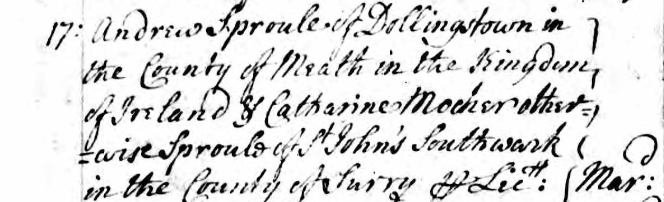
But here is something rather strange! There was another marriage for the same couple – they got married a second time, one month after the ‘clandestine marriage’. On 15 May 1753 in St Giles, Camberwell, Southwark, Surrey, England, we have the second marriage. [6]  And would you look here...

2nd Marriage of Andrew Sproue Esq and Catharine Mocher 15 May 1753
This Andrew Sproule who married Catharine Mocher in 1753 came from Dollingstown, County Meath, Ireland. We have him - and he was an Irish Sproule after all! I know exactly where to go now to find out more about Andrew Sproule Esq. father of our Captain Andrew Sproule - to James Sproule’s book, "Eight Centuries of the Spreull and Sproule Families". For Andrew Sproule from Dollingstown, County Meath has to be an Athlone Sproule, and James’ book will tell us who he is.

And of course it did!

Andrew Sproule esq. was the son of Joseph Sproule, who was the second son of Captain John Sproule of Longfield, Westmeath, who died in 1730. Joseph Sproule’s line of this Athlone Sproule family are Quakers, so I wonder if that had something to do with the ‘clandestine’ first marriage of Joseph’s son Andrew and his wife Catharine Mocher? Or was it simply money after all.

James Sproule tells us in his book that the brother of Catharine Mocher is Flower Mocher. Well nobody’s going to forget that name, and I certainly didn’t! A few months ago I came across a Major General Flower M. Sproule, Colonel in the British Royal Artillery.

This officer was appointed 1st Lieutenant in the Royal Artillery 21st July 1779 and rose to Major General the 1st of January 1812. So Major General Flower Mocher Sproule was a younger brother of our Captain Andrew Sproule of the Solebay. Flower Sproule had no children, so this interesting name died out!

So now we know that our Captain Andrew Sproule of the Solebay was born in January 1763, probably in Bathford House, Bathford, Somerset. He died 8 Nov 1822 in Clifton, near Bristol. He married Harriet Letitia, who was born about 1761 and who died in Cheltenham, on 30 Aug 1832.

The father of Captain Andrew Sproule was Andrew Sproule Esq. of Bathford, who died on the 13 June 1794 in Kemerton, Wychavon District, Worcestershire. His grave inscription reads:

Sacred to the Memory of
Andrew Sproule Esq.
of Bath in the County of Somerset,
who departed this Life
to the inexpressible regret of his family
and friends at his House in this Parish
June 13, 1794 Aged 74 [7]

Andrew Sproule Esq. was born 1720 in Athlone, Ireland. He married Catharine Mocher in 1753 and they had 3 sons and 3 daughters. [8]

Andrew Sproule Esq. was the son of Joseph Sproule of Athlone, the second son of Capt. John Sproule of Longfield. For further information on this family see Eight Centuries of the Spreull and Sproule Families by James R. Sproule.

UPDATE

James Sproule, from Eight Centuries of the Spreull and Sproule Families, has very kindly forwarded a picture of a real treasure that James has been given. This spoon belonged to Captain Andrew Sproule. It has his initials, the date 1790 and RN engraved on it. Thank you James!


References:

[1] Bristol Archives; Bristol, England; Bristol Church of England Parish Registers; Reference: P/AL/R/3/a, Ancestry.com

[2] Somerset, England, Church of England Burials, 1813-1914, Ancestry.com. 

[3] City of Westminster Archives Centre; London, England; Westminster Church of England Parish Registers; Reference: SGCM/PR/1/3 Ancestry.com

[4] London, England, Clandestine Marriage and Baptism Registers, 1667-1754, Ancestry.com

[5] General Register Office: Registers of Clandestine Marriages and of Baptisms in the Fleet Prison, King's Bench Prison, the Mint and the May Fair Chapel, National Archives. 

[6] London Metropolitan Archives; London, England; Reference Number: P73/GIS/001, Ancestry.com

[7] St. Nicholas Churchyard, Kemerton, Wychavon District, Worcestershire, England, Findagrave.com

[8] Eight Centuries of the Spreull and Sproule Families by James R. Sproule.